Today's topic of conversation is margin rates, that is, the rate your broker charges you on a margin loan. The margin rate can have a profound impact on an investor's overall return and may even be the make-or-break factor in determining whether a given trading strategy will be profitable. 

To illustrate, let's consider the following example: say we have a investment strategy designed to produce average annualized returns of 5%. While 5% may sound meager to some investors, imagine that our strategy is a highly risk controlled one that hedges out most of the risk of overall market fluctuations (this could be a long/short portfolio for example). Therefore, leveraging the strategy up to 4 to 1 is both feasible and prudent. So, without margin (i.e. using leverage) the portfolio produces 5% annualized returns, but at a leverage ratio of 4 to 1, the porftfolio produces returns of 20%. 

Sounds great, no?

Alas, the story is never so simple. The missing piece here is that we need to deduct the cost of the margin loan from the portfolio's return. So, if our margin rate is say, 6%, then we will end up incurring a negative 1% loss for any leverage we take on (since it costs us 6% to make a return of 5%). Obviously, the cost of the margin loan negates the profitability of the trading strategy.

Now this is where it becomes interesting. The most indelible shift during the past 15 years in the brokerage industry has been the emergence of discount brokers, with their constant drive towards lower costs. Generally speaking, the effect this has had on commission structures has been to drive the entire industry towards similar commissions, as well as greater transparency on commission charges. While different discount brokers have different commission schedules, they are all within a competitive range.   

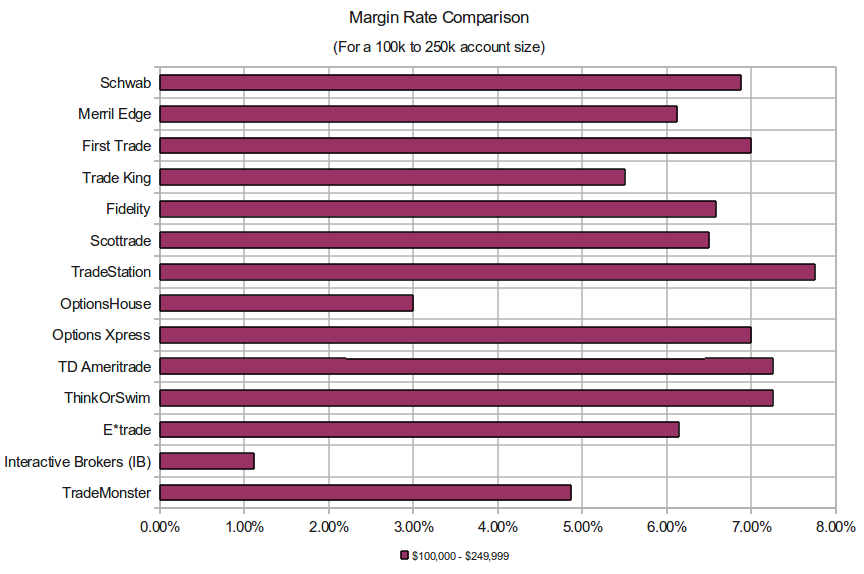
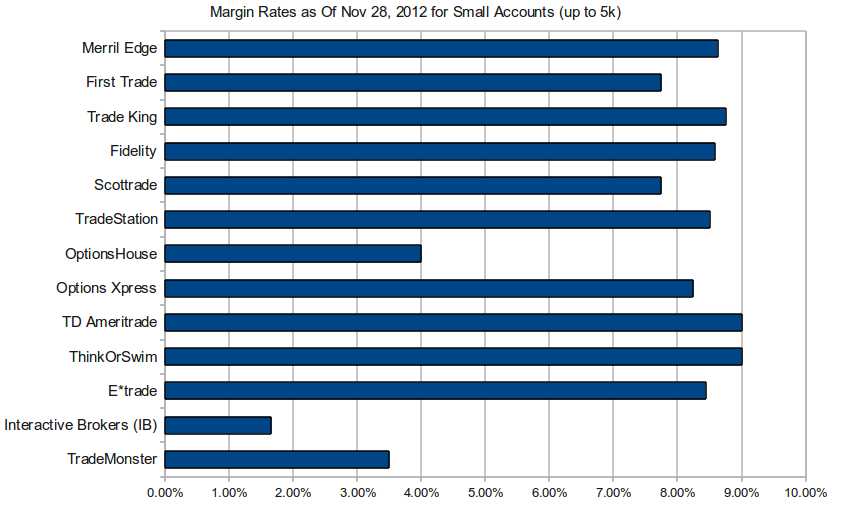
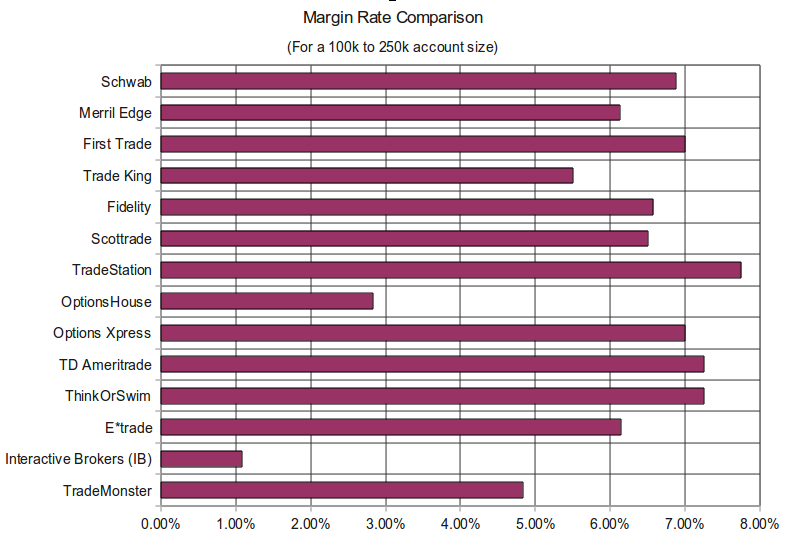
What's surprising is that the same cannot be said about margin rates. There is a huge range of margin rates across different discount brokers as is illustrated in exhibit 1 below.
Margin Rates for discount brokers
Exhibit 1. Margin rates as of May 1, 2012. Source: Interactive Active Brokers website.
Exhibit 1 isn't comprehensive by any stretch of the imagination, however, it does illustrate the point. Going back to our trading strategy described earlier, only Interactive Brokers, ETrade and Fidelity charges a margin rate that would make our strategy profitable. Moreover, the strategy with Etrade and Fidelity only becomes profitable if we have an account net equity value of 1.5 million or more.

What's the lesson here? Choose your broker wisely. The margin rate can be just as important (if not more important) than commission rates, execution, technology, or service.


I recently came across a highly insightful 2010 working paper out of the University of Sydney Business School entitled "Portfolio Margining: Strategy vs Risk" by E.G. Coffman, JR & D. Matsypura & V.G. Timkovsky.

The paper explores a number of different ideas including the riskiness of regular Reg-T margin versus Portfolio margin, the impact that the Portfolio Margin Pilot program may have had in terms of contributing to the stock market crash of October 2008, and the authors' belief that strategy-based margin has been unfairly discredited as a result of misinformation about the computational complexity of the strategy-based margining problem combined with the general bias towards heuristics by those (typically of the lawyer mindset) setting strategy-based margin rules.

Here is the abstract for the paper: 
This paper presents the results of a novel mathematical and experimental analysis of two approaches to margining customer accounts, strategy-based and risk-based. Building combinatorial models of hedging mechanisms of these approaches, we show that the strategy-based approach is, at this point, the most appropriate one for margining security portfolios in customer margin accounts, while the risk-based approach can work efficiently for margining only index portfolios in customer margin accounts and inventory portfolios of brokers. We also show that the application of the risk-based approach to security portfolios in customer margin accounts is very risky and can result in the pyramid of debt in the bullish market and the pyramid of loss in the bearish market. The results of this paper support the thesis that the use of the risk-based approach to margining customer accounts with positions in stocks and stock options since April 2007 influenced and triggered the U.S. stock market crash in October 2008. We also provide recommendations on ways to set appropriate margin requirements to help avoid such failures in the future.
The paper is quite advanced and may not be accessible to the average reader. However, for the technically inclined reader, the paper is definitely worth a read as it contains thought provoking examples of how Portfolio Margin can cause a pyramiding of debt under certain plausible market scenarios. 

So what does this all mean? Admittedly, not that much for the average investor. 
However, this paper and the concepts it contains should be read and mastered by anyone who works in margin and risk control at a brokerage firm. I applaud the authors for their work. 

For your conveniance, I've included a copy of the paper below.
 
 
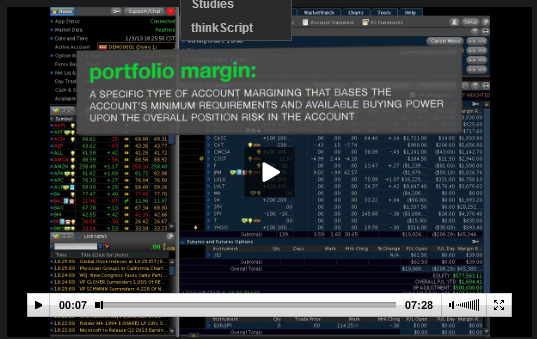
The good folks at www.tastytrade.com have posted an interview with Scott Sheridan, the co-founder of thinkorswim (acquired by TD Ameritrade in 2009). The video discusses Portfolio Margin. I've embedded the video below. 

Informative? Honestly, not really. 
Unfortunately, the video is short on substance and long on ad-hoc commentary. While Scott is clearly articulate and knows his stuff, only the first six minutes of the video is really focused on portfolio margin. That said, I applaud the folks at tastytrade for continuing to produce useful and original videos for the trading community.   
 
 
bxm
Much has been made in recent years of the so called "buy-write" index (ticker:BXM) and its related ETFs (ticker:PBP). For the layman, a buy-write index ETF encapsulates a covered call writing strategy in a simple, buy and hold product.

The hoopla around this index is not surprising given that it has outperformed the S&P 500 index insofar as risk-adjusted return in concerned. With investors hungry for returns yet also weary from the volatility seen during the 2008/2009 financial crises, the buy-write ETF offers an attractive alternative to a passive long index fund.

Without further ado, let's get straight to the charts. The performance of the buy-write index (the ticker is BXM) versus the S&P 500 index (GSPC) can be seen below. As is evident, the BXM significantly outperforms the S&P 500 over the five year period from 2007 to 2012. 
So now you're interested, right? Let's explore this strategy in more detail.
The first question is: What exactly is a buy-write strategy and the BXM index?
 
The term "buy-write" was coined by the CBOE (which was one of the first companies to compile an index reflecting the returns of a covered call index strategy). The premise is simple - The CBOE's BXM index represents a strategy that: 
(1) buys a S&P 500 stock index portfolio, and
(2) "writes" (or sells) the near-term S&P 500 Index (SPXSM) "covered" call option, generally on the third Friday of each month.
In other words, the BXM is just a continuously managed covered call strategy written against the S&P 500 index.

The key advantage of a buy-write strategy is the superior risk/return profile. The idea of "better risk adjusted returns" isn't hollow rhetoric. There is plenty of justification to be found in a growing body of literature examining the strategy's characteristics. In one of the more comprehensive studies to date, Kapadia and Szado (in a September 2011 paper "15 Years of the Russell 2000 Buy‐Write") show that a strategy of selling out-of-the-money covered call options on the Russell 2000 produces higher returns than a simple Russell 2000 position. Further, the buy-write strategy comes with about a third less overall volatility than the pure long Russell 2000 strategy. 
As a general rule of thumb, a buy-write strategy should produce returns similar to (or slightly less than) the S&P 500 index, but with about 50% to 70% of the volatility.
The results of the Kapadia et al (2011) study, combined with other similar studies can be used to substantiate the following claim. As a general rule of thumb, a buy-write strategy should produce returns similar to (or slightly less than) the S&P 500 index, but with about 50% to 70% of the volatility
The final major advantage of the buy-write index (and the primary reason I'm blogging about it) is that it qualifies for Portfolio Margin treatment. In particular, it's falls within the High-Capitalization Broad Based Indexes Group, which means that the stress test range applied is: -8% to 6%. With such a small market move being applied to determine the margin requirement, taking a leveraged position in PBP is extraordinarily easy. By leveraging up to say, 1.3 to 1 , the fund will have about the same volatility as an S&P 500 fund (ticker:SPY), but with a much higher return expectation. 

The key point of all this is that a buy-write ETF in a margin account can provide more bang for the buck than your traditional S&P 500 ETF. As modern portfolio theory teaches us, smart investors should always seek out higher risk-adjusted return investments and simply leverage up to a level of risk commensurate with their own unique risk appetite.
 
 
It's no surprise that we at The Margin Investor are big proponents of Portfolio Margin. Here is our tongue-in-cheek (but completely true) list of why we think portfolio margin rocks.
1. Leverage for spread traders
Do you trade the spread between two ETF's? Do you trade complex option strategies like calendar spreads, straddles or collars? Want to create a long/short portfolio? 
Advanced trading strategies rely on leverage. With Portfolio Margin it's possible to achieve leverage up to 10 to 1. 
Portfolio Margin is designed for spread traders. Traditional Reg T?  Not so much.
Picture
2. Postpone Capital Gains Tax
How about an interest free loan from the government?
Yep, a Portfolio Margin account can be used to postpone capital gains tax on your big stock winners for...well...forever.  
Billionaires aren't the only ones who can take advantage of this tax loophole...

3. All you can eat dividends!
There are so many high quality stocks with dividend yields well over 5%. Here's a simple strategy: Create a portfolio of dividend yielding stocks. Leverage this up using portfolio margin, and sit back and collect the dividends. With margin borrowing rates less than 1.5%, a 4 to 1 leveraged portfolio can have a net yield of over 20%.  
Concerned about the risk of this type of portfolio? No problem, simply hedge out market fluctuations by shorting the S&P 500 ETF (SPY). What's left over? A pure stream of cashflow. 
Picture
4. Maintenance Margin = Initial Margin = Easier Trading
Traditional Reg T margin forces you to post higher capital at the time you enter a position (compared to the margin needed for existing positions). 
Portfolio margin simplifies this and gives you just one number which defines the margin requirement. Focus on your trading not on your margin.

5. Smart Hedging
Systemic risk is such a huge concern these days. Any moment Europe's financial crises could take down the world economy. It's prudent to be concerned about your portfolio's exposure to this. So I ask you: What are you going to do about it?
Clearly, it's not practical to unwind your portfolio as this would incur huge commissions and could trigger taxable capital gains.

With portfolio margin it's remarkably simple to execute a hedge. Here's how: short an ETF. 
With so many ETFs trading these days it's easy to find one that tracks your portfolio and can act as a good short term hedge. When the European crises subsides, simply close the short and you'll be back to your original portfolio. It can't get any simpler than that folks.  

The bottom line is that Portfolio Margin gives traders and investors the flexibility you need when you need it.      
 
 
Jesse Drucker of Bloomberg recently published an article (see Buffett-Ducking Billionaires Avoid Reporting Cash Gains to IRS) discussing the growing list of billionaires caught in the IRS's increasingly more dim view of prepaid variable forwards (PVF).  

PVF's have become the "go-to" tax strategy for high net worth individuals seeking to monetize unrealized capital gains on publicly traded stock without actually triggering a taxable event. The PVF is simply a forward contract where the owner of the stock agrees to sell a variable number of shares to the counterparty at a fixed time in the future. The number of shares varies with the price of the security such that the total value of the sale is within a fixed range (the range is usually around 15% so that the IRS's constructive sale rule can be avoided). The PVF contract is packaged with an up-front loan from the securities buyer to the securities seller. The economic essence of the PVF transaction is that the securities seller gets paid up front (via the loan) but doesn't deliver the securities until some point in the future.
To fully grasp the attractiveness of the PVF it's important to understand two key assumptions:
Picture
1. Since the PVF is a single contract and title to the securities isn't transferred until the future, the IRS does not consider this a capital gain until the forward delivery date. Thus, capital gains taxes can be postponed.

Picture
2. From a securities regulatory standpoint, the PVF is viewed as a stock sale (i.e. not a loan) and therefore not subject to Federal Reserve Reg-T. This is a major advantage since the full proceeds of the loan can be used for any purposes. Basically, this is an end-run around Reg-T's 50% margin requirement. 

Now it appears that - based on recent IRS rulings - assumption #1 is no longer the slam dunk it once was and billionaires like Billy Joe McCombs (the former owner of the Minnesota Vikings, San Antonio Spurs, and co-founder of Clear Channel Communications) is the latest casualty of the IRS' crackdown on the PVF strategy. Yikes!

So what's a billionaire to do? 

Thomas Boczar and Doug Engman of Intelligent Edge Advisors make a compelling case for a substitute transaction with the same (or perhaps even more attractive) economic substance but with a much lower tax and IRS audit risk. In their article Portfolio Margin - Recent Developments in Single Stock Concentration, they argue that a collar and loan transaction within a Portfolio Margin Account can be used to obtain the same economic and tax benefits as the PVF. This is only possible under the new portfolio margining rules because of the lower margin requirements obtained (versus the traditional Reg-T margin).

The premise of their approach is to construct a collar position using exchange traded or otc options. This would involve selling a call option and buying a put option to hedge the security in question. A substantial percentage of the overall position value can then be withdrawn in cash from the brokerage account (or invested in other securities) as the Portfolio Margining methodology considers the position to be hedged. This all happens with the Options Clearing Corporation as the counterparty so there is less credit risk than with the PVF offered to you by your friendly neighborhood, bail-out seeking Wall St. broker-dealer (Goldman Sachs, Morgan Stanley, Citigroup, JP Morgan, etc). And guess what? It's all kosher as far as the IRS is concerned.

Billionaires rejoice! 
 
Joking aside, the collar strategy under Portfolio Margining rules is an effective tax management approach for any investors wishing to postpone capital gains tax on large single stock positions with substantial unrealized capital gains. All investment advisors worth their salt should familiarize themselves with this approach.  


It's shocking, albeit not totally surprising that E*Trade - the once formidable on-line discount brokerage pioneer - has taken such an incredibly long time to get into the Portfolio Margin game. Their September 2011 announcement that they will now be offering Portfolio Margin Accounts comes well over three years after the SEC's approval of Portfolio Margin. Considering that brokers such as Interactive Brokers have had Portfolio Margin offerings available for several years now, it's no wonder that E*Trade's stock price has had such an unpleasant run in recent years.   
Now, I'm not here to bash their stock, but the lack of attention to such an attractive potential client base (under FINRA rules, portfolio margin accounts must have at least 100k in net equity value) begs the question: What is E*Trade's management focusing on?

This all has to be put in context of course. In the grand scheme of things Portfolio Margin is still relatively new and there is plenty of time for brokers to compete for business. One thing is clear though, E*Trade is once again behind the pack.